Table of contents
Using sensory rooms for physical rehabilitation can improve movement, balance, body awareness, and motivation by turning therapy goals into structured, sensory-rich experiences. When designed well, a sensory room supports rehabilitation by reducing anxiety, increasing engagement, and giving therapists a controlled environment to practise gross motor, fine motor, postural, vestibular, and proprioceptive skills. Drawing on established sensory integration principles and practical room design knowledge, the most effective spaces are those that match sensory input to the person’s physical goals rather than simply filling a room with equipment.
Highlights
- Sensory rooms can support physical rehabilitation by improving balance, coordination, strength, body awareness, and participation.
- The best results come from linking each sensory feature to a specific therapy goal, such as gait training, reaching, posture, or calming before movement work.
- Effective setups differ across home, school, and clinic settings, but all need clear zoning, safe layout, and adaptable equipment.
- Poor sensory design can overstimulate users and reduce progress, while thoughtful design increases focus, regulation, and functional outcomes.
What does using sensory rooms for physical rehabilitation mean?
Using sensory rooms for physical rehabilitation means delivering movement-based therapy in a space designed to influence how the nervous system receives and responds to sensory input. In practical terms, the room is used to help a person move more effectively by adjusting light, sound, touch, visual tracking opportunities, floor surfaces, and body-positioning equipment. Rather than separating sensory regulation from physical therapy, the room combines both.
This approach is especially valuable for children and adults who struggle to engage in conventional rehabilitation settings. A child with autism may be physically capable of stepping onto a balance beam but unable to tolerate the noise and unpredictability of a standard therapy gym. An adult with dementia may mobilise better in a calm, familiar sensory space than in a busy clinical ward. A sensory room can lower distress and increase readiness for movement, which often leads to better repetition, better quality of movement, and more meaningful progress.
There is strong reason to take this seriously. The NHS notes that physical activity and tailored rehabilitation can play an important role in maintaining strength, balance, and independence across many conditions, while autism-related sensory differences are widely recognised by the NHS and the National Autistic Society. Separately, the World Health Organization has reported that rehabilitation needs are rising globally, with billions of people likely to benefit from some form of rehab support during illness or injury recovery according to WHO.
Why sensory rooms work so well in rehabilitation
Physical rehabilitation depends on repetition, motivation, feedback, and safety. Sensory rooms help with all four. A controlled sensory environment reduces competing input, making it easier for the body and brain to focus on the movement task. When distractions are lowered, users can better attend to cues such as “shift weight to the left foot,” “reach across midline,” or “hold upright posture for five seconds.”
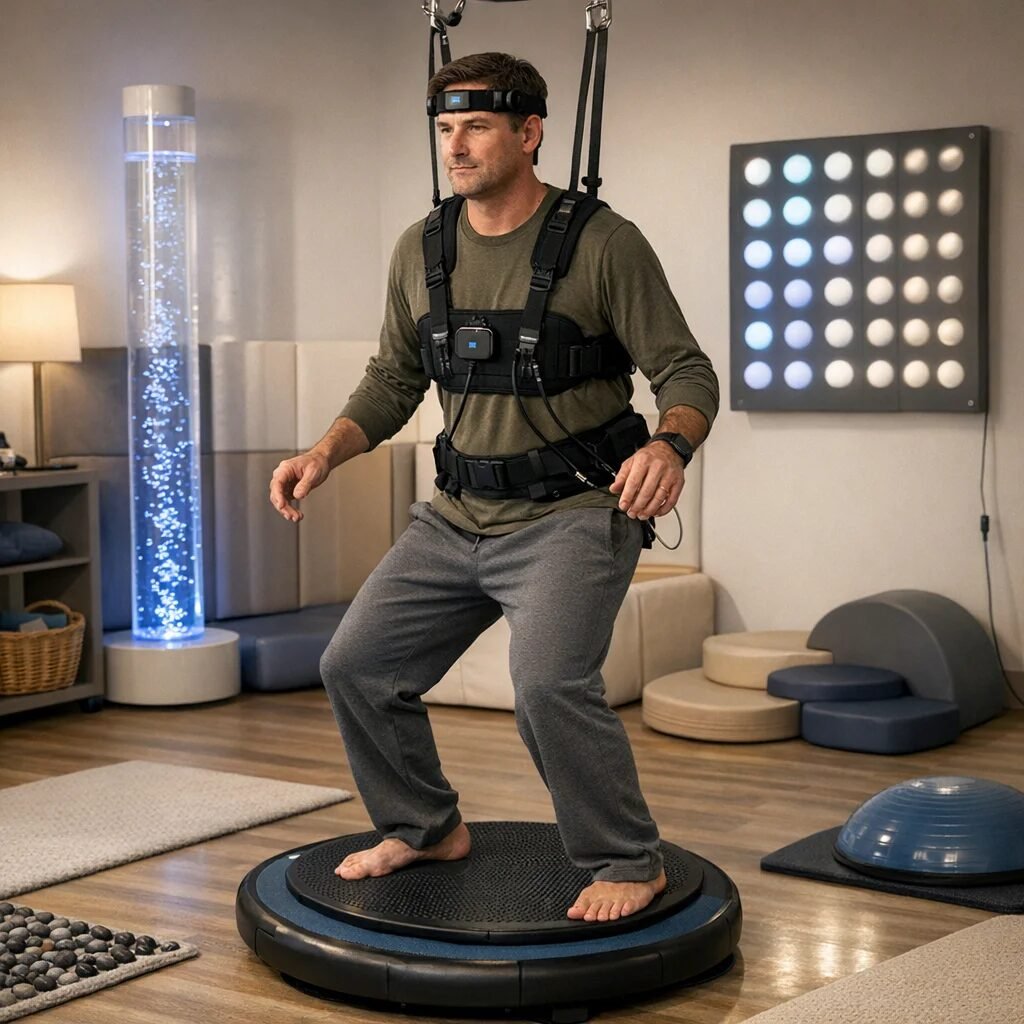
They also provide immediate sensory feedback. For example, a person reaching toward coloured lights, illuminated panels, or projected targets has a clear visual goal that can improve upper limb extension and trunk rotation. A child standing on a textured pathway receives tactile and proprioceptive information that supports weight shifting and foot placement. A suspended swing or rocker can be used carefully to challenge vestibular processing and postural control when clinically appropriate.
Motivation is another major advantage. Traditional rehabilitation exercises can feel repetitive, especially for children and individuals with attention or sensory regulation differences. In a sensory room, “three minutes of standing tolerance” becomes “watching the bubble tube while staying upright,” and “cross-body reaching” becomes a game using lit targets. This shift from demand to engagement often leads to more repetitions without the person feeling over-pressured.
The contrast between effective and poor practice is stark. In an effective setup, a therapist dims overhead lighting, uses one visual focal point, and provides a stable seating system before introducing controlled reaching tasks. In a poor setup, flashing lights, multiple sounds, cluttered floor space, and unrelated equipment overwhelm the user before any meaningful movement work begins. The first supports neural organisation; the second creates noise in every sense.
Physical goals that can be addressed in a sensory room
Balance, posture, and core stability
Many people in rehabilitation need support with postural control. This includes children with developmental delays, adults recovering from neurological events, and individuals with sensory processing difficulties who appear clumsy or unstable. Sensory rooms can help by offering graded balance challenges in a lower-stress environment. Soft but stable floor zones, rocker boards, wedge shapes, wall support, and visual fixation points can all be used to improve upright control.
A practical example is a child who avoids standing tasks in a bright school hall but will tolerate supported standing beside a calming light source in a sensory room. The room allows the therapist to extend standing time, encourage symmetrical weight bearing, and introduce reaching without triggering sensory defensiveness. For some users, simply reducing auditory overload improves muscular organisation enough to allow better alignment and endurance.
Gait training and mobility
Sensory rooms can be adapted for early walking practice, stepping patterns, obstacle negotiation, and transitions such as sit-to-stand. Visual trails, illuminated targets, and textured walking paths can encourage longer step length, safer foot placement, and better pathfinding. Where space allows, the walking route should be clear, predictable, and free from visual clutter. The room should invite movement, not trap it.
For users with dementia, mobility work may be improved when the room feels reassuring rather than clinical. For autistic children, a clearly marked route with reduced environmental noise can prevent shutdown or bolting. In both cases, the physical goal is movement, but the sensory design is what makes movement possible.
Upper limb function and motor planning
Rehabilitation often requires repeated reaching, grasping, release, shoulder stability work, and bilateral coordination. Sensory rooms are excellent for this because they allow targets to be positioned at different heights, distances, and angles. Light-up panels, wall-mounted activity boards, and tactile swap-in resources can be arranged to encourage shoulder flexion, hand opening, crossing the midline, and graded force.
Motor planning improves when the room offers simple, meaningful sequences. For example, a therapist might ask a child to step onto a marker, press a glowing panel, crawl through a short tunnel, then return to seated position. This sequence develops planning, timing, and multi-step movement organisation. When too many choices are presented at once, motor planning often deteriorates, so fewer stations usually produce better quality movement.
How to set up a sensory room for rehabilitation
Step 1: Start with therapy outcomes, not equipment
The first step is to identify the physical skills being targeted. Is the goal improved head control, greater shoulder range, safer transfers, better balance reactions, longer walking tolerance, or stronger body awareness? Once the outcome is clear, sensory tools can be chosen to support it. This prevents a common mistake: buying popular sensory items that look impressive but add little value to rehabilitation.
For example, a room intended for physical rehab should not rely solely on passive visual stimulation. A bubble tube may help regulation and visual tracking, but it should sit within a wider plan. If a child needs trunk rotation and supported kneeling, the room must include floor space, bolsters, and reachable targets. If an adult needs sit-to-stand practice, the room needs stable seating, transfer space, and carefully placed prompts.
Step 2: Zone the room by regulation and movement demand
Effective rooms typically include at least two zones: a calming regulation area and an active therapy area. The calming area helps the user settle, organise attention, and recover between tasks. The active area is used for goal-directed movement. In larger spaces, a third transition zone can support changes between floor work, supported seating, and standing tasks.
Zoning matters because physical performance changes with regulation level. A child who crashes into equipment may first need deep pressure and reduced light before balance work becomes productive. An adult with ADHD may respond better when heavy movement tasks are separated from visual relaxation tools. A person with dementia may need a simple, familiar seating area before attempting mobility tasks. For broader sensory design principles in specialist spaces, this guide to sensory rooms for individuals with developmental disabilities offers useful context.
Step 3: Choose equipment that gives feedback
The most useful rehabilitation equipment provides clear sensory feedback linked to movement. Visual targets support reaching and tracking. Textured surfaces support foot awareness. Resistance items support proprioception. Seated or floor-based positioning tools support alignment. Equipment should help the user feel where their body is in space and whether the movement goal has been achieved.
Simple tools can be highly effective. TWIDDLERS Sensory Anti-Gravity Hourglasses Colours can be used for visual tracking during prone positioning, supported sitting, or timed standing tasks. Liquid timers are especially useful for users who tolerate movement practice better when there is a calm visual anchor. In spaces that need more foundational planning, reading about how to create a sensory room on a budget can help prioritise functional purchases over decorative ones.
Step 4: Build in progression
Rehabilitation only works when the challenge can be graded. A sensory room should make it easy to alter duration, height, speed, resistance, distance, or complexity. A reaching activity can begin in side sitting with one target at shoulder height, then progress to kneeling with two alternating targets, then to standing with weight shift. A walking path can begin as a straight route on firm flooring, then progress to varied textures or stepping over low obstacles.
This is where many home and school spaces falter. They contain pleasant sensory features but no obvious progression pathway. The room should allow a therapist, teacher, or parent to answer one key question: what is the next achievable step for this user? If the answer is unclear, the setup needs refinement.
Adapting sensory rehabilitation for different users and settings
Home environments
At home, space is often limited, and the room may need to support both regulation and therapy. The best home sensory rehab setups are compact, safe, and routine-based. A parent might use a beanbag or wedge for postural support, a wall target for reaching, a short textured path for barefoot foot awareness, and a calming visual tool to mark rest breaks. Sessions often work best when brief and predictable.
One common success pattern is pairing rehab tasks with a familiar sequence. For example: two minutes of calming visual attention, five sit-to-stands, three wall reaches each side, a short stepping route, then a preferred sensory reward. This structure is usually more successful than expecting a child to tolerate a full therapy-style block without sensory breaks.
Schools and specialist education
In schools, the sensory room should not become a place where pupils simply “go to calm down” with no therapeutic purpose. It can be a powerful intervention area for movement breaks, postural work, hand function tasks, and readiness-to-learn routines. Teachers and therapists should agree on which pupils need regulation first, which need active input first, and how long each intervention should last.
Poor school setups often mix every type of sensory input together and allow unrestricted use. Effective school setups use timetables, visual rules, simple session aims, and staff training so that equipment is used consistently. If a pupil is working on crossing the midline and seated posture, staff should know exactly which station supports that and how to cue it.
Therapy clinics and multi-user spaces
Clinic settings can support more advanced physical rehabilitation because they often have better space, mounting options, and specialist oversight. Even so, the same principles apply: clear goals, clear zoning, and controlled sensory input. Rooms serving multiple users should have changeable settings so they can suit a child with sensory seeking behaviour in one session and an adult with neurological fatigue in the next.
Therapists often benefit from portable resources that move between stations. TWIDDLERS Sensory Anti-Gravity Hourglasses Colours can be used in fine motor stations, timed balance work, or calming recovery corners between more demanding activities. Although simple, products like this earn their place when they support a measurable task rather than acting as filler.
Common mistakes and how to avoid them
The most common mistake is treating sensory design as decoration rather than intervention. A room full of glowing items may look impressive but fail completely as a rehabilitation environment. If equipment does not support posture, movement planning, regulation, or feedback, it should not dominate the room. Every item should have a purpose tied to function.
Another frequent problem is too much stimulation. Flashing lights, layered music, moving projections, strong scents, and textured flooring all at once can overwhelm many users, particularly those with autism or sensory processing disorder. The better approach is selective sensory input. Choose one or two channels to support the task. For a standing exercise, that may mean a dimmed room, one visual target, and no background music.
Safety oversights also undermine otherwise good rooms. Unstable furniture, poor transfer space, slippery flooring, and cluttered walkways turn a therapeutic setting into a risk. In physical rehab spaces, routes must be wide and obvious, wall edges should be considered, and all equipment should be compatible with the user’s mobility level. A calming room that causes trips and poor transfers is not therapeutic.
Finally, many rooms fail because staff or family members are not shown how to use them. A well-designed sensory room needs a simple operating plan: who uses it, for how long, for which goals, with which cues, and how progress is recorded. Without this, even a high-quality room becomes inconsistent and underused.
Expert tips for getting better outcomes
Use the room before the user becomes dysregulated, not only after. Physical rehabilitation is usually more effective when the person enters in a calm, organised state. Waiting until a child is distressed or an adult is exhausted limits what can be achieved. Scheduled sensory preparation often works better than reactive sensory rescue.
Pair sensory experiences with measurable goals. Instead of saying “the user enjoyed the room,” record “maintained kneeling for 45 seconds while tracking liquid timer,” or “completed six supported side steps toward illuminated target.” This turns sensory work into evidence-informed practice rather than anecdotal experience.
Keep one variable changing at a time. If a balance task becomes harder, avoid also increasing noise, changing lighting, and altering instructions. Controlled progression allows the therapist or caregiver to identify what helped and what caused difficulty. This matters particularly for users with ADHD, autism, or neurological conditions where the line between sensory support and overload can be very fine.
Where rehabilitation involves emotional or behavioural barriers as well as movement challenges, broader sensory planning can help maintain continuity across interventions. This article on the benefits of sensory rooms for children with behavioral challenges is relevant for teams supporting regulation and physical access together.
Frequently Asked Questions
Can a sensory room help with physical rehabilitation?
Yes. A sensory room can support physical rehabilitation by improving regulation, attention, balance, posture, motor planning, and willingness to participate in movement tasks. It works best when each sensory feature is linked to a clear therapy goal.
Who benefits most from sensory-based rehabilitation spaces?
Children and adults with autism, ADHD, sensory processing disorder, developmental delay, neurological conditions, dementia, and anxiety-related movement difficulties often benefit. The room is especially helpful for people who struggle in busy or overstimulating therapy environments.
What equipment is most useful in a sensory room for rehab?
The most useful equipment is equipment that provides feedback and supports movement goals. This includes visual targets, supportive seating, textured surfaces, safe floor mats, body-positioning tools, and calm visual items such as TWIDDLERS Sensory Anti-Gravity Hourglasses Colours. Decorative items without therapeutic purpose should not dominate the space.
Are sensory rooms suitable for home rehabilitation?
Yes, if they are planned carefully. A home sensory rehab area does not need to be large, but it does need safe layout, predictable routines, and equipment matched to the user’s goals such as reaching, standing, stepping, or calming before exercise.
How long should a sensory rehabilitation session last?
Session length depends on the person’s age, stamina, and condition. Many users do well with short structured sessions of 10 to 30 minutes, especially when calming and active tasks are alternated. Quality of engagement matters more than length.
What is the biggest mistake when using sensory rooms for physical rehabilitation?
The biggest mistake is overstimulation. Too many lights, sounds, and features can reduce focus and worsen movement quality. The most effective rooms are selective, purposeful, and easy to adapt.